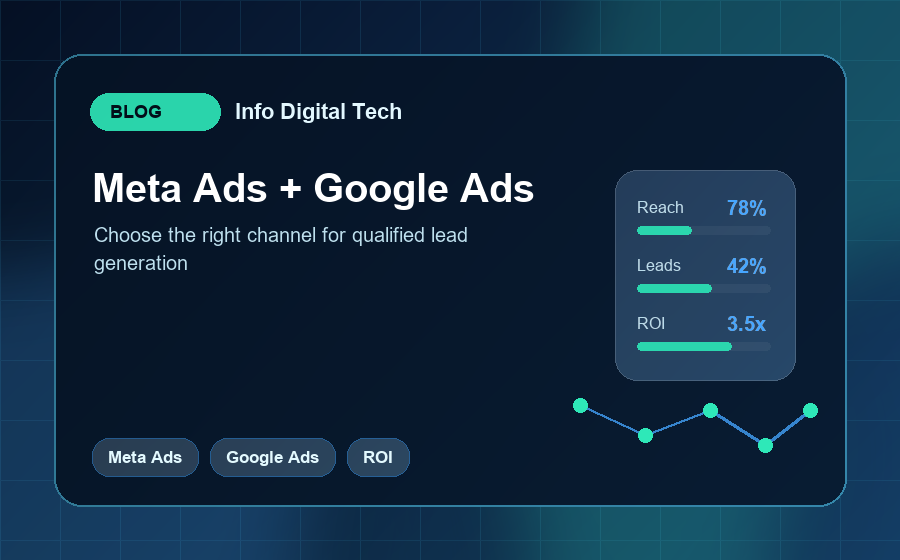
Meta Ads vs Google Ads: How to Choose the Right Lead Generation Channel
Understand when to use Meta Ads, when to use Google Ads, and how both platforms can work together to generate better leads for service and local businesses.
Many businesses ask the same question before starting paid marketing: should we run Meta Ads or Google Ads? The correct answer depends on customer intent, service type, budget, landing page quality and the speed at which the business wants leads. Both platforms can generate enquiries, but they work in different ways and should not be judged using the same expectations.
Google Ads is intent-driven. A person searching for “website development company near me”, “best digital marketing agency”, “dentist in Rajkot” or “industrial packaging supplier” is already looking for a solution. Search campaigns can capture this demand at the moment of need. That is why Google Ads often works well for services with clear search demand, urgent requirements, high-value leads or location-based intent.
Meta Ads is attention-driven. People on Facebook and Instagram are not usually searching for a service at that moment. The ad must interrupt the feed with a strong visual, relatable problem, attractive offer or proof-based message. Meta Ads performs well when the product or service can be demonstrated visually, when awareness is needed, when retargeting is important or when the offer needs repeated exposure before enquiry.
The landing page changes the result on both platforms. Google traffic may be high-intent, but it will still waste budget if the landing page is slow, unclear or missing trust signals. Meta traffic may be colder, so the landing page must educate quickly and reduce doubt with benefits, testimonials, portfolio, pricing guidance, FAQs and easy contact options. For lead generation, the page should focus on one service and one action instead of distracting visitors with too many choices.
Budget also affects channel selection. A small budget on Google should focus on exact services, high-intent keywords and a limited location. A small budget on Meta should focus on strong creatives, a specific audience and retargeting visitors or engaged users. Spreading a low budget across too many campaigns usually creates weak data and poor optimization.
Creative strategy is more important on Meta. Businesses should test different hooks such as problem-solution, offer, result, testimonial, comparison, behind-the-scenes and educational formats. Short videos, reels-style edits, carousel explanations and clear lead magnets can work well. The first three seconds matter because the user is scrolling.
Keyword and search-term control is more important on Google. A campaign should regularly review search terms, add negative keywords, improve ad copy and split services into focused ad groups. If one ad group mixes unrelated services, the quality score and conversion rate can drop. Google Ads rewards relevance between keyword, ad and landing page.
The strongest setup often combines both platforms. Use Google Ads to capture people actively searching for the service. Use Meta Ads to build awareness, explain benefits, show proof and retarget users who visited the website but did not enquire. When tracking is configured correctly, the business can see how both channels support the final lead.
Choose Google Ads when demand already exists and customers search with clear intent. Choose Meta Ads when the business needs awareness, visual storytelling, retargeting or offer-based lead generation. Use both when the goal is not only quick enquiries but a full digital growth funnel that keeps the brand visible from first discovery to final decision.